

Table of Contents
You want to know exactly how much time sits between two calendar dates. A two dates calculator works it out instantly — giving you the total days between dates, plus that same gap expressed as weeks between dates and months between dates. You can also flip the question and find what date falls a certain number of days before or after a starting point. No mental arithmetic, no counting on a calendar, no second-guessing whether February has 28 or 29 days that year.
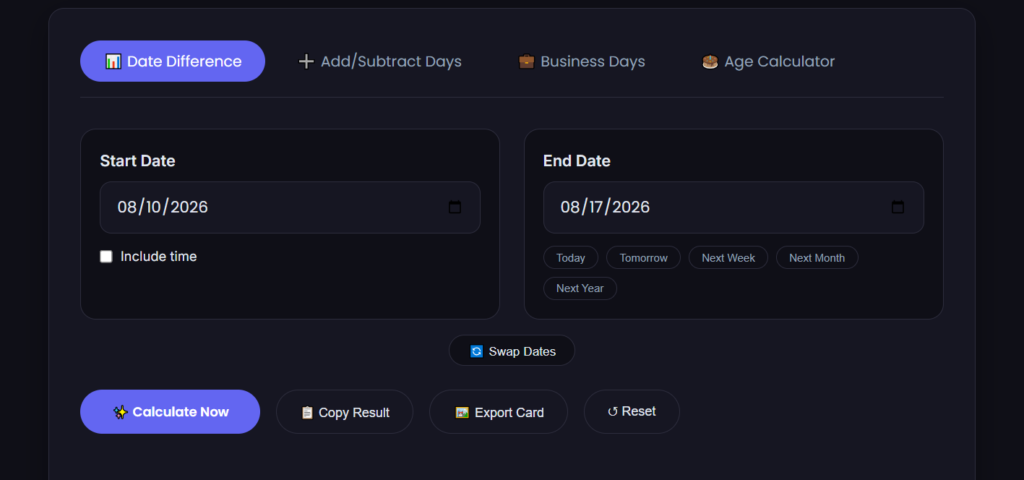
If you need an answer right now, our date-to-date calculator handles it free — just pick your two dates and it breaks down the difference every way you're likely to need.
What "Days Between Dates" Really Means
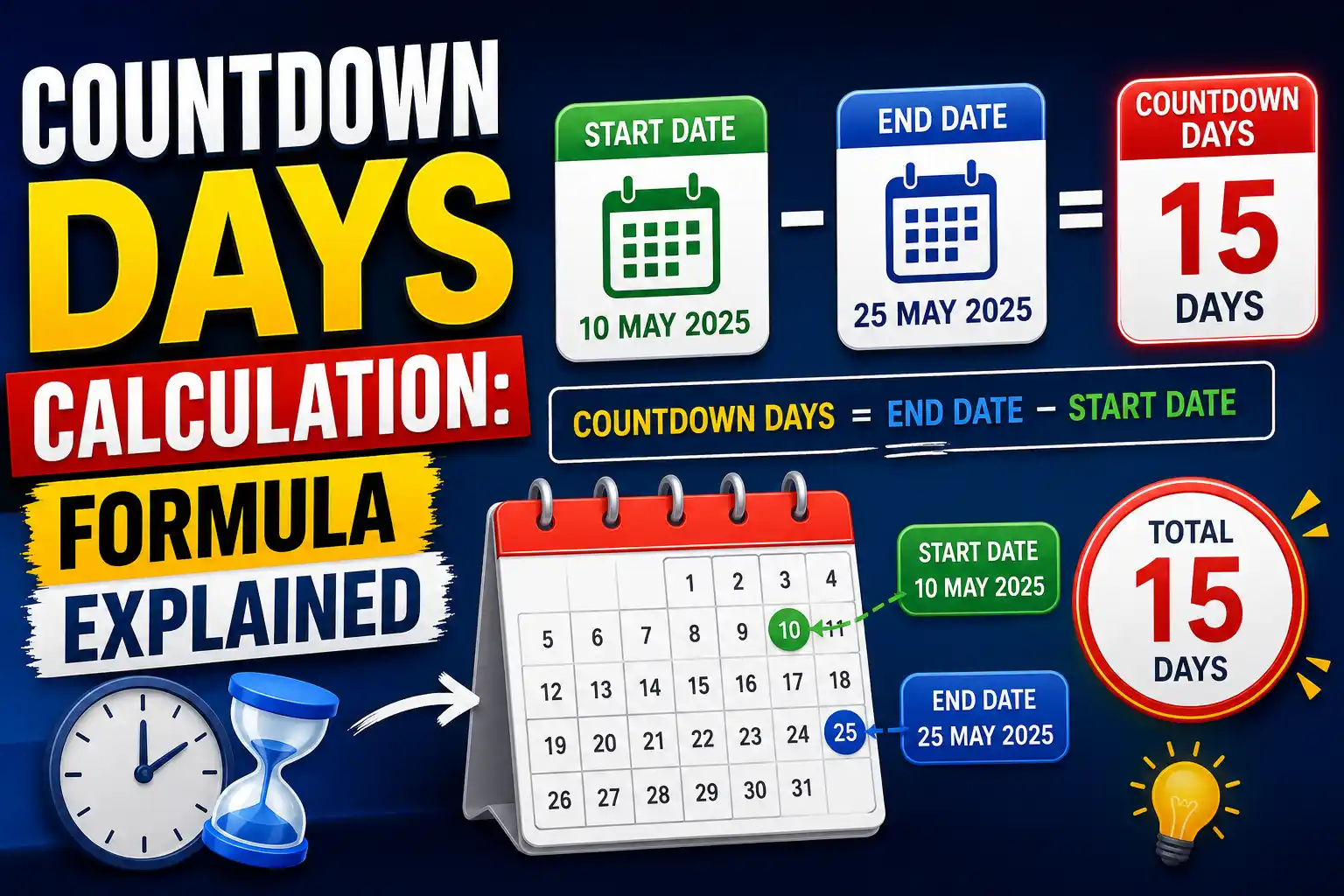
When a tool shows the days in between dates, it usually counts the calendar days from the start date up to but not including the end date. For example, Monday to the following Monday is 7 days, not 8. That matters when you're counting down to an event, calculating interest days for an invoice, or figuring out exact age in days. A good time between dates calculator makes this distinction obvious instead of leaving you to guess which counting method it uses.
The same gap gets shown as weeks and days (e.g., 21 days becomes "3 weeks"), and as months and days (e.g., 95 days might show as "3 months, 4 days," where the calculator defines a month as roughly 30.44 days on average). Because real calendar months have different lengths, the months-between figure is always an approximation unless the tool maps actual calendar months between your two specific dates — and our tool shows both a precise day count and a clean weeks-plus-days breakdown so you can use whichever format suits your purpose.
Worked Example: Moving House
Let's say your lease ends on 15 November 2026 and your new place becomes available on 3 December 2026. You need to know the gap so you can plan temporary storage or a short-term rental. Here's the calculation:
- Start date: 15 November 2026
- End date: 3 December 2026
Count the days remaining in November after the 15th: 16th through 30th gives 15 days. Then add the 3 days in December before the 3rd (meaning December 1, 2 — the tool counts days up to but not including the end date unless you specify otherwise). That gives 15 + 2 = 17 full days between the two dates.
Expressed other ways:
- Days between dates: 17 days
- Weeks between dates: 2 weeks and 3 days
- Months between dates: approximately 0 months and 17 days (less than one full calendar month)
That 17-day window becomes your practical planning figure — enough time to arrange a short stay or book storage without paying for a full extra month you don't need. Plug those dates into our two dates calculator yourself and you'll see the same numbers, plus the option to include or exclude the end date depending on your specific situation.
Why Mental Math Trips You Up
Calendars are irregular by design. Months run 28, 29, 30, or 31 days. Leap years insert an extra day every four years — except they skip it in century years not divisible by 400. A days between dates calculation that spans February in a leap year will differ by one day compared to a non-leap-year span with the same nominal dates. Counting manually, most people forget to check the year first.
Week boundaries add another layer. If you're calculating weeks between dates, does a Wednesday-to-Wednesday span count as exactly one week, or do you need full Monday–Sunday weeks? Different use cases want different answers. Payroll cycles, school terms, and rental agreements rarely align neatly with calendar-month boundaries, which is why having the gap expressed as a clean number of weeks plus leftover days is often more useful than a fractional month.
When to Use a Time Between Dates Calculator
This isn't just for curiosity. Real-world tasks that rely on precise date gaps include:
- Project planning: how many working days (or total calendar days) between a kickoff meeting and a delivery deadline.
- Contract durations: whether a 90-day notice period lands on a weekend or holiday, and what the exact calendar date will be.
- Age verification: calculating exact age in years, months, and days for eligibility cutoffs — school enrollment, sports divisions, retirement benefits.
- Pregnancy tracking: counting weeks from a known conception or last menstrual period date to estimate due dates, where a time between dates calculator that outputs weeks and days is especially handy.
- Travel bookings: many visa rules count entry days precisely, and a hotel booking "14-night stay" needs to land on the right checkout date.
- Invoice payment terms: net-30 from invoice date — what's the actual due date when months have different lengths?
In every case, the core question is the same: what's the exact gap, and what's the date on the other side of it. A two dates calculator answers both directions.
Why Our Tool Shows the Gap Multiple Ways
Different audiences need the same gap expressed in different units. A project manager might need to know it's 47 days between dates for a sprint countdown. A teacher planning a term might want it in weeks between dates (6 weeks and 5 days). A financial contract might call it out in months between dates (1 month, 17 days). Showing all three prevents you from having to run separate calculations or convert manually, reducing the chance of an off-by-one error that ripples into a real problem.
The date-to-date calculator on MiniToolsPro also lets you toggle whether the end date is included in the count, because some real-world scenarios count the final day (like hotel stays) and others don't (like a notice period where the last day is the effective date). That single toggle can change the result by exactly one day, and plenty of disputes start there.
Direction Matters: Forward or Backward
A days in between dates calculation works in both directions. You can start with two dates and get the gap, or start with one date and a number of days to find the target date. For example, "What's 90 days from 1 March 2026?" lands on 30 May 2026 in a non-leap year. But "What date is 90 days before 1 June 2026?" depends on whether you count the start date or not — most tools count backward excluding the start date, giving 3 March 2026. Try both in the calculator and compare; the difference between including and excluding the start date is exactly one day, and for time-sensitive deadlines that matters.
This bidirectional use makes the same tool serve two common query types that people often think need separate calculators: "days between two dates" and "what date is X days from now."
Common Pitfalls and How to Avoid Them
Forgetting leap years. If you manually count days across February without checking the year, you'll be off by one day roughly 24% of the time. A calculator handles this invisibly. Just make sure you're entering the correct year — sounds obvious, but it's a frequent slip when someone types in a date from memory.
Mixing up inclusive versus exclusive counting. If your event starts on a Monday and ends on a Friday, is that 4 days or 5? The calculator gives you a setting for that, but you need to know which convention your context expects. Legal and financial documents usually state it explicitly; if they don't, clarify.
Time zone assumptions. Pure date calculators that ignore time of day avoid time zone complications, which is a feature, not a bug, for most planning tasks. If you need hour-level precision across time zones, you need a different tool.
Assuming equal month lengths. The "months between dates" output is useful for rough planning but shouldn't be used for financial calculations that depend on exact day counts. Stick to the total days figure for anything that has money or legal consequences attached.
FAQ
How do I calculate the number of days between two dates?
Pick your start and end dates, decide whether you want to include the end date in the count or not, and let a two dates calculator handle the rest. It automatically accounts for month-length differences and leap years, giving you the exact number of calendar days in seconds. You can also see that span expressed as total weeks and remaining days. If you're doing it manually, you'd count the days remaining in the start month, add the full months in between, then add the days into the final month — but a tool removes the risk of arithmetic mistakes.
What's the difference between "days between" and "days in between" dates?
For most calculators, "days between" two dates means the number of full calendar days from the start date up to but not including the end date. So Monday to Wednesday is 2 days. If your situation requires counting the end date too (e.g., a rental period that includes both check-in and check-out day), you need a calculator that offers an inclusive-count option — otherwise your result will be off by one day. Many people searching for days in between dates are actually asking for that inclusive count, so it's worth checking which mode you need.
Can I use this to find a future date by adding days or weeks?
Yes. Enter a start date and a number of days, weeks, or months to add (or subtract), and a time between dates calculator will give you the resulting calendar date. This works for questions like "what date is 180 days from today" or "what was the date 6 weeks ago." The same tool that calculates the gap between two fixed dates can also project forward or backward from a single date.
One Tool, a Lot of Everyday Questions Answered
A two dates calculator isn't just about counting squares on a wall calendar. It's the quickest way to settle arguments over deadlines, double-check contract terms, plan trips and projects, and verify ages or eligibility dates without letting calendar quirks lead you astray. The next time you're wondering "how many days until..." or "what date was 90 days ago," you already know where to get a fast, free answer — and see it broken down three ways at once.
For a broader look at date calculations and how they work across different scenarios, read our main guide to date calculators for more examples and use cases.
Share this article 👇


0 Comments